Italy elections: Who's who and how the vote works
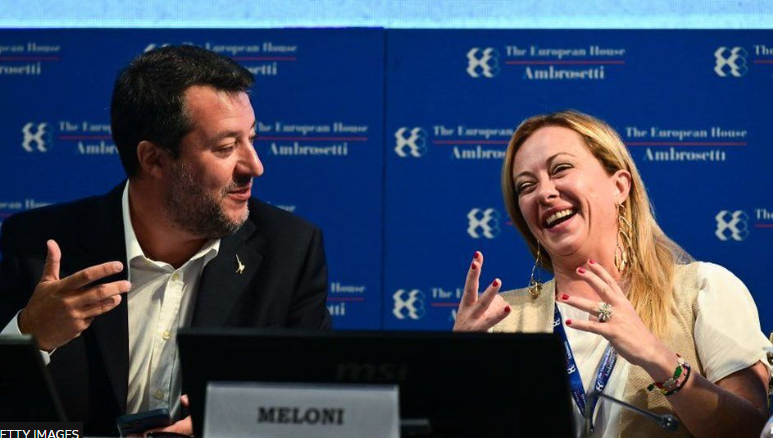
For the first time since World War Two, Italy's next leader could come from the far right
Giorgia Meloni's Brothers of Italy party is leading the polls ahead of 25 September elections - and if she wins, she will look to form a right-wing government.
Two months after the collapse of Mario Draghi's unity government, here's what you need to know about the main challengers and how Italy's revamped elections work.
Giorgia Meloni
Four years ago, her party attracted little more than 4% of the vote in the last general election and yet she's now is in pole position to win, with a possible quarter of the vote. Backed by two other parties, the League and Forza Italia, polls suggest she is heading for a majority coalition in Italy's two houses of parliament.
Giorgia Meloni, 45, was the only major party leader who refused to go into popular technocrat Mario Draghi's broad-based coalition, so she was the only big opposition leader when it collapsed in July.
She formed Brothers of Italy (Fratelli d'Italia) in 2012, four years after becoming Italy's youngest-ever minister under Silvio Berlusconi in 2008.
As a teenager, she joined the youth wing of Italy's neo-fascist movement, formed after the war by supporters of late dictator Benito Mussolini. In her 2021 book, I Am Giorgia, she stresses she is not a fascist, but she identifies with Mussolini's heirs: "I have taken up the baton of a 70-year-long history."
Unlike her right-wing allies, she has no time for Russia's Vladimir Putin and is pro-Nato and pro-Ukraine, even though many voters on the right are lukewarm on Western sanctions. Besides tax cuts, her alliance wants to renegotiate Italy's massive EU Covid recovery plan and have Italy's president elected by popular vote. To change the constitution, she would need a two-thirds majority in parliament.
Embracing a controversial old motto, "God, fatherland and family", she campaigns against LGBT rights, wants a naval blockade of Libya and has warned repeatedly against Muslim migrants.
She also seeks a "different Italian stance" towards the EU's executive body. "That does not mean that we want to destroy Europe, that we want to leave Europe, that we want to do crazy things," she says.
Enrico Letta, 56, was prime minister for 10 months in 2013-14 and is no stranger to Italy's cut-throat politics. He led a coalition with Silvio Berlusconi's Forza Italia and was ultimately brought down by a rival in his own party, Matteo Renzi.
A big supporter of Mario Draghi's government, Mr Letta said Italians would punish those who brought him down in July, pointing the finger squarely at the populist Five Star Movement under Giuseppe Conte. Mr Letta has found common cause with former Five Star leader Luigi di Maio, who fell out with Mr Conte and formed a new centrist party called Civic Commitment (Impegno Civico).
The centre-left leader's main goal is to stop the hard right taking power in Italy. He wants investment in renewable energy and proposes an eight-point plan for education under the banner "knowledge is power".
The PD backs a €9 (£8; $9) minimum wage to cover some three million workers and wants to: make it easier for children of immigrants to obtain citizenship; combat anti-LGBT discrimination and legalise gay marriage.
line
Italy's new election system
The winning alliance will need a majority in both houses of parliament, the Chamber of Deputies and Senate, and Italians are voting for both of them.
New rules mean parliament has shrunk by a third, so there will now be 400 deputies in the Chamber, instead of up to 630 MPs, and 200 Senators instead of 315.
Italy has a hybrid voting system, in which three-eighths (about 36%) of members are elected in a first-past-the-post vote in single-member constituencies. The rest are elected by proportional representation according to party lists of candidates, with seats reserved for voters abroad.
Voters need to be 18 and get one vote for the Chamber and one for the Senate. Parties have to secure at least 3% of the vote to get in, with Italy divided into 27 electoral districts. Final opinion polls were published on 7 September, including this one from Ipsos.